|
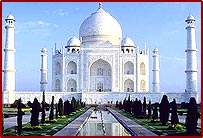 The
State is situated in Northern part of India and is surrounded by
Tibet & Nepal in the North, Madhya Pradesh in the South, Haryana,
Delhi & Rajasthan in the West and Bihar in the East. Often
referred to as the cow belt or Hindi belt, Uttar Pradesh has been
the most dominant state in Indian poltics and culture since
Independence, producing over half of India's prime ministers. This
is partly because it's the nation's most populous - it has as many
inhabitants as Brazil - and partly because of the central role the
region plays in the religious lanscape of Hindus. The Ganges River,
which forms the backbone of Uttar Pradesh, is the sacred river of
Hinduism, and four of the religion's seven holy towns are in the
state, including Varanasi, the holiest of them all. Uttar Pradesh is
also a places of major importance to Buddhists for it was at Sarnath,
just outside Varanasi, that the Buddha first preached his message of
the middle way. Most of Uttar Pradesh consists of the vast Ganges
plain, an area of awesome flatness which often floods dramatically
during the monsoon. The scenic north-western corner has hill
stations sprinkled along the foothills of the Himalya, boasts
excellent trkking and rises to form some of the highest mountains in
India. The
State is situated in Northern part of India and is surrounded by
Tibet & Nepal in the North, Madhya Pradesh in the South, Haryana,
Delhi & Rajasthan in the West and Bihar in the East. Often
referred to as the cow belt or Hindi belt, Uttar Pradesh has been
the most dominant state in Indian poltics and culture since
Independence, producing over half of India's prime ministers. This
is partly because it's the nation's most populous - it has as many
inhabitants as Brazil - and partly because of the central role the
region plays in the religious lanscape of Hindus. The Ganges River,
which forms the backbone of Uttar Pradesh, is the sacred river of
Hinduism, and four of the religion's seven holy towns are in the
state, including Varanasi, the holiest of them all. Uttar Pradesh is
also a places of major importance to Buddhists for it was at Sarnath,
just outside Varanasi, that the Buddha first preached his message of
the middle way. Most of Uttar Pradesh consists of the vast Ganges
plain, an area of awesome flatness which often floods dramatically
during the monsoon. The scenic north-western corner has hill
stations sprinkled along the foothills of the Himalya, boasts
excellent trkking and rises to form some of the highest mountains in
India.
Contact for any kind of
information about Uttar Pradesh
How
to Get There
By
Air: Lucknow, the capital of Uttar Pradesh, is well
connected by air with New Delhi, Patna, Calcutta and Mumbai.
By Rail:
Lucknow is an important junction of the Northern and North
Eastern Railways. It is well connected with all important cities of
India.
By Road: Lucknow is well
connected with New Delhi (497 km), Agra (363 km), Calcutta (985 km),
Kanpur (79 km) and Allahabad (225 km).
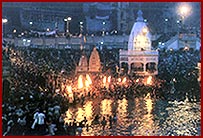 Capital:
This is the land that Lord Rama is said to have gifted his brother,
Laxman. The exotic land of the Nawabs -- Lucknow. The land of
exquisite sunrises and sunsets. Legendary gardens, palaces, mosques
and bazaars. Towering minarets and golden cupolas. Fresh water-melon
and Jasmine flowers, Fish, 'biryani' and 'ittar' perfumes. charcoal
stoves and ghazals, Silver smiths and sequin embroiderers.
Industrialists and romantics. Sweet 'phirni', poetry and betal leaf.
Spicy gossip and 'kababs'. Capital:
This is the land that Lord Rama is said to have gifted his brother,
Laxman. The exotic land of the Nawabs -- Lucknow. The land of
exquisite sunrises and sunsets. Legendary gardens, palaces, mosques
and bazaars. Towering minarets and golden cupolas. Fresh water-melon
and Jasmine flowers, Fish, 'biryani' and 'ittar' perfumes. charcoal
stoves and ghazals, Silver smiths and sequin embroiderers.
Industrialists and romantics. Sweet 'phirni', poetry and betal leaf.
Spicy gossip and 'kababs'.
History:
In the
Vedic period, Uttar Pradesh formed part of the ancient country,
Madhyadesha. From the 16th -18th c., it was the Mughals who remained
rulers. The British gradually extended their power west from Bengal
in the 19th century, and UP became the main scene of the Mutiny of
1857 against the British. The area was in the forefront of the
Indian independence movement; six of the first nine prime ministers
of independent India (including Jawaharlal Nehru and his daughter,
Indira Gandhi) were from Uttar Pradesh.
Contact for any kind of
information about Uttar Pradesh
The People: Two
ethnographic groups inhabit the state--Mongoloid peoples in the far
north near the Tibetan border and Aryan-Dravidian people in the
plains and the hill and plateau region of the central and southern
part of the state. Hindus constitute more than 80 percent and
Muslims, more than 15 percent of the population. Hindi is the mother
tongue of most, with about 15 percent speaking Urdu. The western
plain is the most urbanized region. Agriculture is by far the most
important sector of the state's economy, employing about
three-fourths of the work force.
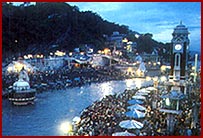 Culture:
The Kathak dance style, nurtured in Uttar Pradesh, is the most
popular form of classical dance in India. Old centres of learning -
Varanasi, Allahabad, Lucknow - were local points for classical music
and dance. This is the home of many a great artiste: Hin- dustani
classical vocalist Siddheshwari Devi, Kathak dancers like Birju
Maharaj and mainstream actors like Amitabh Bachchan. Today, foreign
nationals have also learnt this elegant dance form to perfection:
the beautiful Veronique Azan being one example. The songs and dances
of the countryside are significant features of local culture. They
include the kajari of Mirzapur and Varanasi; the Alha Udal, a folk
epic; and various village dances. Culture:
The Kathak dance style, nurtured in Uttar Pradesh, is the most
popular form of classical dance in India. Old centres of learning -
Varanasi, Allahabad, Lucknow - were local points for classical music
and dance. This is the home of many a great artiste: Hin- dustani
classical vocalist Siddheshwari Devi, Kathak dancers like Birju
Maharaj and mainstream actors like Amitabh Bachchan. Today, foreign
nationals have also learnt this elegant dance form to perfection:
the beautiful Veronique Azan being one example. The songs and dances
of the countryside are significant features of local culture. They
include the kajari of Mirzapur and Varanasi; the Alha Udal, a folk
epic; and various village dances.
Contact for any kind of
information about Uttar Pradesh
Handicrafts:
Bhadohi, Khamaria and Mirzapur are famous for carpet weaving;
Farrukhabad for handprinting; Lucknow, for chikan (a type of
embroidery); Moradabad, Varanasi, for brocade and brass ware and
Nagina, for its ebony work. UP is the largest Brass and Copperware
making region in India with thousands of establishments. In
domestic-ware each of the scores of lotas (small water-pots) is
known by the name of its origin, like Etawah, Banaras, Sitapur, etc.
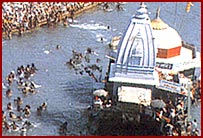 CLIMATE:
The entire state, except for the northern region, has a tropical
monsoon climate. In the plains, January temperatures range from 12.5º-17.5º
C and May records 27.5º-32.5º C, with a maximum of 45º C.
Rainfall varies from 1,000-2,000 mm in the east to 600-1,000 mm in
the west. CLIMATE:
The entire state, except for the northern region, has a tropical
monsoon climate. In the plains, January temperatures range from 12.5º-17.5º
C and May records 27.5º-32.5º C, with a maximum of 45º C.
Rainfall varies from 1,000-2,000 mm in the east to 600-1,000 mm in
the west.
Population:
167 million
Festivals:
International Yoga Week in Rishikesh in Feb; Taj Mahotsav in Feb;
Jhansi festival in Feb-March; Rang Gulal festival in March; Buddha
Mahotsav (Apr-May);Badri-Kedar festival in June; Vrindavan
Sharadotsav in Oct; Garhwal festival in Oct-Nov; Ganga festival in
Oct-Nov; Kumaon festival (Nov);Lucknow festival (Nov-Dec).
|



 Visa
Information
Visa
Information  Golden
Triangle
Golden
Triangle